Module 2 · VOGraph AI + Voyage Graph LLM
Every voyage adds an edge.
A traveller is not a vector, not a tree, not a row in a database. A traveller is a graph. VOGraph AI joins the demand-side Guest Graph to the supply-side Destination Graph through match edges — and the set of all those edges is the matrix ZnVO reasons over.
432 dims
Traveller DNA across 6 categories.
≈97%
Verified feasibility with Z3 SMT + OR-Tools CP-SAT.
0.6%
Feasibility of raw-LLM itinerary output, unverified.
P95 < 2.4s
Five-stage discovery pipeline including intent.
The four-DNA matrix
One engine, four products
Because the match is bidirectionally symmetric, the same computation answers four different questions: what should this traveller do, who should this destination attract, which bundles can this curator win, and where does this supplier truly fit.
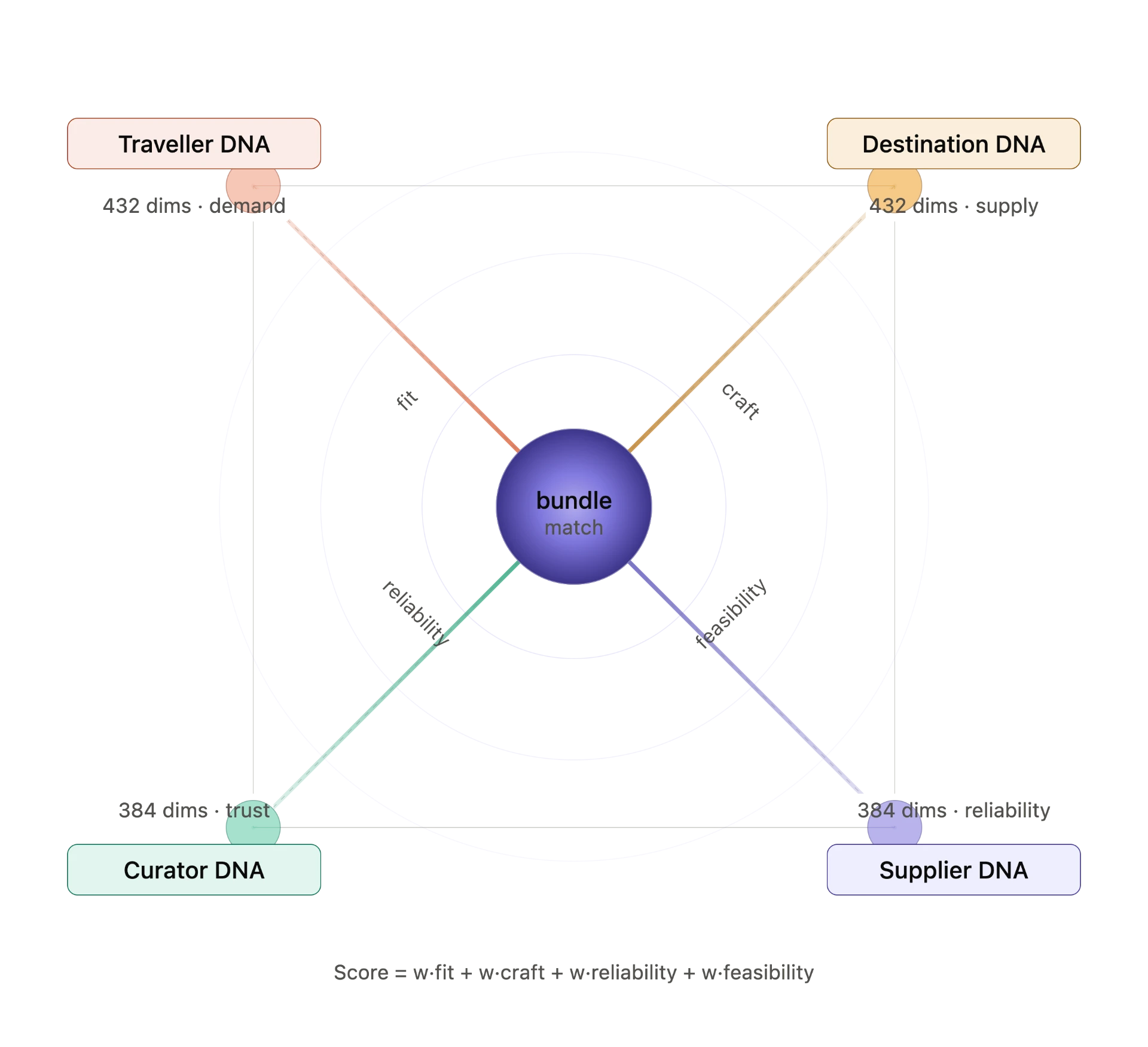
Traveller DNA
fit432 dims · 6 categories · Demand
Who a traveller actually is — rhythm, tolerance, memory, company, constraint. A traveller is not a row in a database; a traveller is a graph.
Destination DNA
craft432 dims · 9 categories · Supply
Destinations as first-class graph entities with their own attributes, relationships and mutable offering parameters.
Curator DNA
reliability384 dims · 8 categories × 7 curator types · Trust
The craft of the human who assembles the journey — what they know, where they operate, who trusts them and what they deliver on time.
Supplier DNA
feasibility384 dims · 8 categories × 5 supplier types · Reliability
Deliverability as data: connectivity depth, on-time performance, cancellation behaviour, claims acceptance.
Feasibility gate
A bundle that cannot be delivered never gets ranked
Language models are excellent at proposing journeys and poor at guaranteeing them. VOGraph passes every candidate bundle through constraint solvers before it can surface, so an itinerary is either verified or it is not shown.
Intent decomposition
Claude Sonnet 4 turns a human ask into constraints in under 200ms.
Graph traversal
Neo4j walks curated, supplied, substitute and evocative relationships.
Constraint proof
Z3 SMT and OR-Tools CP-SAT prove time, geography and capacity feasibility.
Explainable ranking
Each bundle carries the reason it scored, not just the score.
Consent-aware data
A four-level consent model (E/S/D/O) governs what may inform a match.
Tier gates
Airline OTP ≥80% Elite, ≥90% Prestige; IOSA mandatory Elite+; claims acceptance ≥95%.
Under the hood
The stack that carries it
- Intent decomposition
- Claude Sonnet 4 · ≤200ms
- Graph backbone
- Neo4j — CURATED_BY, SUPPLIED_BY, SUBSTITUTES_FOR, EVOKES
- Learning
- PyTorch Geometric GNN · LangGraph · Voyage Graph LLM
- Feasibility solvers
- Z3 SMT + OR-Tools CP-SAT
- Vectors & data
- Pinecone 500M+ · MongoDB Atlas · Kafka + Flink · Redis/Feast
- Surface
- FastAPI · GraphQL · gRPC · Kong · OAuth 2.0 + PKCE · MCP
- Runtime
- Kubernetes + Istio · Spark + Airflow
- Discovery pipeline
- 5 stages + intent ≈ 1,680ms · P95 < 2.4s
Graph vocabulary
Edge types
A Pinecone index of 500M+ vectors, MongoDB Atlas documents and a Kafka + Flink stream keep the graph current, while Spark and Airflow rebuild the heavier features.
ZnVO is pre-launch. Nothing on this site implies live volume, signed curators or paying suppliers. Market and regulatory figures are carried from their original sources and should be re-verified before external use.